
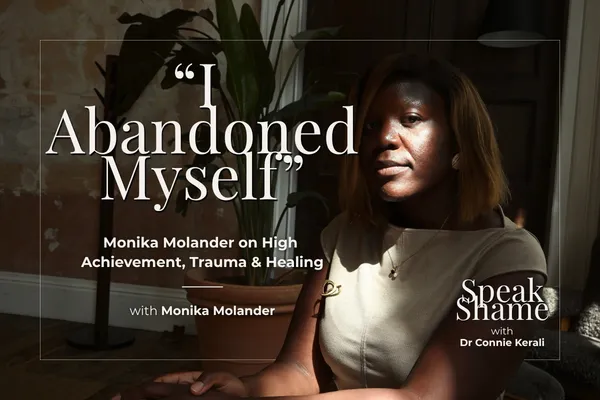
"I Abandoned Myself": Monika Molander on High Achievement, Trauma & Healing


What happens when everything you've built on the outside – the career, the status, the achievements – turns out to be a strategy for surviving the inside? That's the question at the heart of Episode 36 of Speak Shame, where Dr Connie is joined by the remarkable Monika Molander: self-leadership and embodiment coach, former Google and Meta professional, and a woman who spent three decades performing for a love she couldn't find within herself.
Meet Monika Molander
Monika Molander is the founder of her coaching practice, host of the Self-Love Path podcast, and a guide to ambitious women who have placed their self-worth on their achievements, their bodies, and their relationships. Her work sits at the intersection of shame, self-leadership, and what she calls embodiment – the deeply felt, bodily experience of knowing you are enough, exactly as you are.
Her belief, both lived and hard-won: shame doesn't dissolve through silence or willpower. It dissolves through self-discovery.
Growing Up the Outsider
Monika grew up between Sweden and Finland, moving frequently and always the new kid, always the outsider. She was both the interesting one that people wanted to befriend and the one who got bullied, never quite sure which version of herself would be welcomed.
In a loving but emotionally reserved family shaped by Finnish generational wounds – war, survival, stoicism – she learned early that her feelings were inconvenient. "Whatever I'm feeling is wrong and should not be like that," she recalls believing. "I'm too much. I need to silence myself. I need to be less of an inconvenience."
The strategy she settled on was achievement. And she went very, very deep into it. "Everything in my life became about a performance as a way to hopefully get to peace," she says. "Hopefully feel happy and joyful and just get to relax like I assumed everyone else around me was doing."
The Spell of Not Enough
The cruelty of the achievement trap, as Monika describes it, is that it almost works. Every time she reached a goal, she felt a brief wave of peace, enough proof to keep going, to chase the next thing. But the feeling always vanished. "It became kind of a spell that I was under," she says.
In her teenage years, this drive for control extended to her body. After puberty, as she became increasingly aware of the male gaze and the conditions of female acceptance, she developed an eating disorder. Controlling her food felt like the one thing she could manage when everything else felt chaotic. "I can control what I put into my body as a way to not be too much, not be too little. To be perfect."
None of this, she is careful to say, came from a place of vanity. It came from fear. A deep, cellular fear that without perfection, she would be rejected. Exiled. Alone.
Wanting to Belong and the Cost of It
When Monika moved abroad and found community for the first time – real friends, a sense of belonging, a career that was going well – she thought she'd finally made it. What she didn't realise was that a new chase had quietly taken over: the pursuit of love and approval, particularly from men.
"I felt deeply ashamed of wanting connection," she says. "I assumed that okay, if I just fix myself enough, if I just adapt, become less, become more agreeable, less of an inconvenience, maybe then my needs won't be too much."
That loss of self, that constant self-management and people-pleasing, put her in situations that were dangerous. She was sexually abused by someone close to her. And the conclusion she drew, which she now recognises as the logic of a wounded nervous system, not a rational mind, was that this was proof she still hadn't fixed herself enough.
"The belief that my needs are too much, and I'm not allowed to have any needs whatsoever became stronger," she reflects. Rather than leaving, she became more agreeable, more accommodating, more desperate to find the thing she could change about herself that would finally make her welcome.
She couldn't talk about it, either. She knew the advice she'd receive: just leave, just say no, what are you doing? But as she explains with great tenderness, that advice is like telling a five-year-old screaming for her mother to simply go and find someone else. "With the nervous system I had at the time, it was physically impossible."
When Everything Collapsed
Eventually, Monika moved back to Stockholm. The life she'd built abroad – the community, the relationships, the career, the sense of having made it – vanished overnight. Then came a physical accident, multiple surgeries, and COVID, which meant complete isolation while her immune system was already compromised.
She fell into depression. And in that collapse, what she calls a surrender, something shifted. "I didn't really have a faith in a higher power in an embodied way, but something came to me. Somehow this is good for you, because now you can't get any worse."
It was in that space that she found herself drawn to a retreat in Costa Rica. She booked the tickets and went.
The Moment That Changed Everything
At the retreat, working with a shaman, Monika had what she describes as the first felt, bodily experience of loving herself she could ever remember. She saw all the parts of herself she had believed were wrong, shameful, too much, an inconvenience, and was able to embrace them with total acceptance.
And in that moment, she heard something she describes as a divine, motherly voice: How can a child's longing for love be something to feel ashamed of?
Seeing her younger self's strategies – the studying, the perfectionism, the food control, the agreeable-girl performance – through that lens, everything looked different. "There's nothing but love here," she realised. "How can I hate or be ashamed of the need that is beneath all of that? Which is just connection."
She is honest that her life didn't transform overnight. But she had touched the truth, and that changed everything. "Even if I'll go to those old strategies again and again, because it's the default, I know it's not the truth."
The Work She Does Now
Today, Monika coaches high-achieving women who are living the version of her earlier life: building impressive careers and bodies and relationships on the outside, while carrying on the inside the persistent, exhausting belief that they still aren't enough.
What she has found, again and again, is that the most healing thing is simply to be witnessed. To share the thing you are most ashamed of, and be loved in it. "When someone shares what they're ashamed of and they're loved in the shame, the shame disappears," she says. "The entire point of shame is to make us feel wrong about who we are so that we won't be that thing. If we share it and someone says, me too, it kind of vanishes."
She also gently challenges the idea that healing is a destination, something you arrive at and are done with. As we grow, as we step into more authentic versions of ourselves, new shame surfaces at new edges. The practice, she says, is learning to welcome it. To see it as a guide pointing towards the next, truer version of yourself, rather than something to suppress or outrun.
What She Wants You to Know
Monika's advice for anyone feeling stuck in shame is threefold. First, know that you cannot think your way out of it. "It's my thinking that got me there," she says. "More thinking won't solve it." Second, understand that the shame you carry is rarely just yours. It's generational, societal, inherited. It's your responsibility to do something with it, but it was never only about you. And third: tell one person you trust. Name it. Let yourself be seen. "Even if it's just one person, to just voice it: I feel ashamed of speaking up in a meeting. I feel ashamed of my body. This happened to me. And allow someone to see you in it. Because it gives the other person permission to be who they are too."
Listen & Connect
Episode 36 of Speak Shame is available now wherever you listen to podcasts. To find Monika Molander, visit TheSelfLovePath.com or find her on Instagram at @MonikaMolander. You can also listen to her podcast, Self-Love Path, for more on her journey and the work she does.
UK Resources for Support
•In an emergency, dial 999; for non-emergencies or dial 101 (UK only)
•Find your nearest NHS Sexual Assault Referral Centre
•Find an NHS Talking Therapy service near you or contact your GP surgery
•Charities: Mind, The Samaritans, Rape Crisis, Women’s Aid, or Victim Support
---
Your Journey Begins Here
If you or someone you know is grappling with similar experiences, know that you are not alone. Speak up, seek help, and embrace vulnerability as the beginning of your healing journey. Whether through trusted friends, professionals, or community resources, finding someone you can confide in can be life changing. I know this to be true firsthand.
Get in Touch
Join the community:
@DrConnieKerali on Instagram
Sign up for my Born Worthy newsletter to get your weekly dose of empowerment.