

What Runs the World? Shame: Dr. Judith Pilla on Our Most Misunderstood Emotion


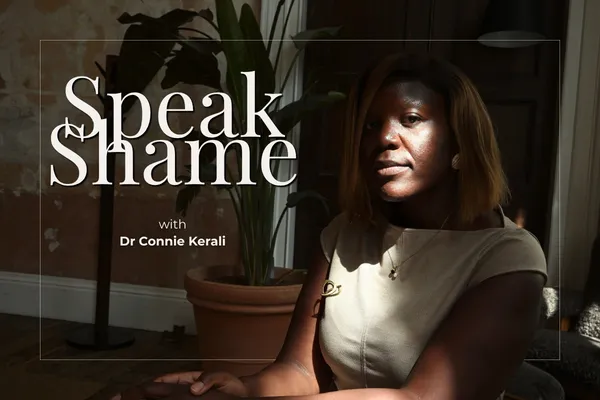
For the Season 4 finale of Speak Shame, Dr Connie sits down with someone who has spent a decade doing what very few people, including most clinicians, have been willing to do: think deeply, rigorously, and honestly about shame.
Dr. Judith M. Pilla is a psychotherapist with over 20 years of clinical experience, and the author of the forthcoming book How Shame Runs the World: Harness the Revolutionary Power of Our Most Misunderstood Emotion. What follows is a conversation that will change the way you understand one of the most powerful forces in your life.
What Shame Actually Is
Most of us have a rough idea of what shame feels like – that sinking, heavy sense of being wrong, inferior, not enough. But Dr. Pilla offers something more precise: shame is a fear-based feeling that we are somehow inadequate compared to what we were meant to be. Inferior. Insufficient. Wrong.
And yet, she argues, even that definition barely scratches the surface because our society has so thoroughly avoided the subject that most of what we think we know about shame is mistaken.
One of the most telling symptoms of this avoidance is how rarely we even use the word. "We always mislabel it guilt," Dr. Pilla explains. "And that's actually because we're too ashamed of shame to think about it or talk about it."
The distinction matters enormously. Guilt, in its traditional sense, is about an action. Something we did wrong. Shame is about the self. It's the difference between I did something wrong and I am wrong. "When you do something wrong, you can do it right the next time," she says. "You can apologise. But shame, when it feels like it's about you as a self, you can't get released from that. It feels like it's part of you."
Babies Are Never Born With Shame
One of the most quietly radical ideas in Dr. Pilla's work is this: no baby is born ashamed. Shame has to come from somewhere outside us. Which means it is, in a very real sense, a foreign object. One that was introduced into us, took root, and became embedded so deeply that we began to treat it as a permanent part of who we are.
This insight is the foundation of everything Dr. Pilla teaches. "Our society treats shame like it's indelibly inside us," she says. "But if it originates outside us, why can't we look at it that way? Why can't we treat it as something removable?"
The answer, she found, is that we can. But first, we have to understand where shame actually comes from and what it is evolutionarily designed to do.
The Evolutionary Purpose of Shame
Here is where Dr. Pilla's research takes a genuinely surprising turn. Far from being simply a destructive, painful emotion, shame is an evolutionary universal signalling system. One that every human being carries, and that exists to protect us.
As a species, humans are physically vulnerable. We don't have claws, shells, or speed. What we have is the capacity to live in social groups and shame is the mechanism that keeps us inside them. It signals when we've violated a group norm, when we've done something that risks our belonging. "Think of it like your pet's invisible fence," Dr Pilla says. "When you do something unacceptable to your group, you get zapped by shame, and that says: uh-oh. Correct course, or you'll be out here alone."
This is what she calls pro-social shame, and it operates quietly in our lives every single day. It's what keeps you from turning up to a wedding in gym clothes or telling your boss you hate his tie. It teaches lessons, maintains social bonds, and protects us from real consequences.
But this is only half the picture.
Two Kinds of Shame and Why the Difference Changes Everything
Alongside pro-social shame sits what Dr. Pilla calls corrosive shame: the kind that simply hurts. Any use of shame that demeans, invalidates, or makes you feel wrong as a person, without teaching any useful lesson, is corrosive. Any form of abuse is corrosive shame. All discrimination, all stigma, all bullying – corrosive shame, every time.
The problem is that we mix the two together constantly, treating all shame as uniformly negative, desperate to get rid of all of it at once. Dr. Pilla uses the image of a marble cake: vanilla batter and chocolate batter, swirled together so completely that you can't separate them. "When we serve shame in our heads, we just think of it all as negative," she says. "But to heal shame, you have to separate them out."
Her approach is simple to understand, even if it takes practice: pro-social shame – use it, then lose it. Learn the lesson, and you no longer need the feeling. Corrosive shame – refuse it, then lose it. It was never legitimate. It was never yours.
Shame in Disguise: Perfectionism, Procrastination, and People-Pleasing
One of the most illuminating parts of this conversation is Dr. Pilla's account of how shame hides in patterns we often think of as personality traits rather than symptoms.
Perfectionism, she explains, is what she calls high shame: the experience of standards being set above what any human being can consistently achieve. When parents tell children to "always do your best," it sounds like encouragement, but it carries a hidden message that your natural abilities are not good enough as they are. "Being perfectionistic actually increases shame," Dr. Pilla says. "Because you can't do it as a general rule."
Procrastination, which so many people carry as a source of shame in itself, is directly linked. Unconsciously, we know we cannot be perfect. So, the healthiest-feeling adaptation is simply not to try. "You put off writing the paper, you put off talking to somebody. Procrastination is actually all about shame. It's putting off the demand that you be better than you can be."
People-pleasing follows the same logic. When you don't feel good enough on the inside, you look to others to tell you that you are. Women, Dr. Pilla notes, are particularly susceptible to this pattern. Not because of any innate weakness, but because of social conditioning. "Women are socialised not to be proud of themselves, not to have large voices, not to have big opinions. But we are approved of when we help and please others. So, women will often adapt a people-pleasing attitude to get some self-esteem, because that's what's more socially acceptable."
The Masks Shame Wears
Shame is also a master of disguise and Dr. Pilla is sharp on two of its most pervasive modern masks.
The first is social media. The anonymity of online platforms makes them uniquely powerful vehicles for shaming others, and for absorbing shame ourselves. "There's actually a huge industry out of shaming on social media," she says, referencing data scientist Cathy O'Neil's concept of the "shame machine" – a multi-billion dollar system in which people are made to feel inadequate so that they'll click, buy, and keep coming back. "All day long, people are trying to persuade us that how we've always done something isn't right. Buy this, do this, and you'll be better. That's a message of shame."
The second mask is projection. When someone insults or demeans you, Dr. Pilla says, it is almost always because they feel ashamed of something inside themselves and they are trying to get rid of that feeling by dumping it onto you. "Off the cuff," she says, "I bet 90% of the shame we feel is projected by other people onto us." A useful test: when you find yourself thinking, that's not what I said or that's not who I am – that's projection. Someone else's shame, handed to you.
Finding Safety Before Speaking
A thread that runs through the whole conversation is the importance of safety. Shame silences. It isolates. And while vulnerability, the willingness to be seen, is often held up as the antidote, Dr. Pilla cautions against a naïve version of that idea.
"You've got to be vulnerable to safe people," she says firmly. "It's not smart to be vulnerable any old place to any old buddy any old time." In her own practice, when a new client sits down and begins pouring out their life story, she stops them. "You don't know me. I'm a stranger to you." Safety has to be earned through repeated, small experiences of being received well before bigger disclosures are made.
Shame Must Change Sides
The episode closes with Dr. Pilla naming her most inspirational woman: Gisèle Pelicot, the French woman who was drugged and raped by her husband and dozens of men over many years and who chose to waive her right to anonymity at trial so that the world could see what had been done to her.
"She was able to recognise that this was corrosive shame," Dr. Pilla says. "Shame inflicted on her. She wasn't the perpetrator. There was no reason for her to feel ashamed. And she ditched that shame and rejected it and then decided to speak up."
The subtitle of Gisèle Pelicot's memoir, Shame Must Change Sides, is also the thesis at the heart of Dr. Pilla's own book. Shame belongs with those who cause harm, not with those who survive it. "Rather than focusing on how you feel as a victim," Dr. Pilla explains, "focus on what the perpetrator has done to you. That's how shame must change sides."
Connect with Dr. Pilla
Dr Judith M. Pilla's book, How Shame Runs the World: Harness the Revolutionary Power of Our Most Misunderstood Emotion, releases on 1st September 2026. To find out more or work with her, visit www.HowShameRunsTheWorld.com.
UK Resources for Support
•In an emergency, dial 999; for non-emergencies or dial 101 (UK only)
•Find your nearest NHS Sexual Assault Referral Centre
•Find an NHS Talking Therapy service near you or contact your GP surgery
•Charities: Mind, The Samaritans, Rape Crisis, Women’s Aid, or Victim Support
---
Your Journey Begins Here
If you or someone you know is grappling with similar experiences, know that you are not alone. Speak up, seek help, and embrace vulnerability as the beginning of your healing journey. Whether through trusted friends, professionals, or community resources, finding someone you can confide in can be life changing. I know this to be true firsthand.
Get in Touch
Join the community:
@DrConnieKerali on Instagram
Sign up for my Born Worthy newsletter to get your weekly dose of empowerment.