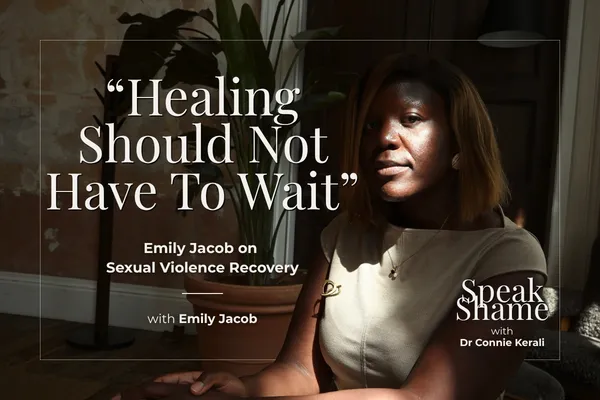
"Healing Should Not Have to Wait": Emily Jacob on Sexual Violence Recovery


What does it look like when a survivor stops waiting for the system to catch up and builds something better herself? That's exactly what Emily Jacob did. And in Episode 35 of Speak Shame, she joins Dr Connie to share the story behind one of the UK's most quietly powerful contributions to sexual violence recovery.
Meet Emily Jacob
Emily Jacob is the founder of ReConnected Life, a trauma-informed recovery organisation whose self-guided programmes are now licensed by more than 20 charities, NHS sexual assault referral centres, and universities across the UK, reaching over 10,000 survivors. She is a keynote speaker, published editor, late-diagnosed autistic and ADHD, and brings both lived experience as a survivor and 25 years of corporate leadership to everything she does.
Her mission, in her own words, is simple: healing should not have to wait.
The Abyss Years
Emily's story doesn't begin with a business plan. It begins with a date in 2008 at a Russian restaurant in London. What happened that night – she suspects she was drugged – left her waking the next morning to find she had been raped.
What followed were six years she refers to as "the disconnected years" or, sometimes, simply "the abyss." Years of nightmares, of only feeling safe sleeping in daylight, of eating microwave macaroni cheese for breakfast, lunch and dinner for three months. Years of eventually getting on a therapy waitlist – three months, which felt interminable at the time, though she notes wryly that three months now would be considered lucky – and emerging from it still not quite healed.
"I thought it was an interminable amount of time," she says of the wait. "But actually it was only three months. I didn't know it would only be three months when I went on the waitlist. And I think that was part of the problem – not knowing."
When therapy eventually came, Emily describes herself as a sullen client. Reluctant to open up. Overwhelmed by tears she couldn't contain. One session stands out: a therapist brought out a set of Russian dolls, and Emily threw one across the room in anger. The therapist was delighted – a flicker of emotion, finally.
Finding a Voice Before She Knew She Had One
During those abyss years, Emily found an unexpected lifeline: early Twitter. It sounds almost strange now, but she describes it as a genuine survivor community. A place where, hiding in a work bathroom having a panic attack, she could reach out and be caught. She began writing too. Dark blogs, honest words, a growing sense that sharing her experience was helping others as much as it was helping her.
Then came Slut Walk. Emily got so involved that a sentence she wrote was chosen as the campaign's slogan. The year after, she spoke at Trafalgar Square. Her very first public speaking experience, before she had any idea she would one day build a recovery organisation. Looking back, she can see that she had already been doing the work long before ReConnected Life existed.
"I started doing this work before the business started," she reflects. "When I was training to be a coach, I was learning so much that helped me feel stabilised, reconnected, hence the name."
Building What She Wished She'd Had
When Emily trained as a coach, she found herself absorbing tools and techniques – NLP, insights from The Body Keeps the Score, frameworks for understanding how trauma lives in the nervous system – and thinking the same thing over and over: I wish I'd known this back then.
So, she packaged it. A three-week online programme, delivered to your inbox Monday to Friday, covering the learning, the self-rescue tools, and the resilience piece, each building on the last. She called it Taste of Recovery, and created it simply because it was everything she wished she'd had access to during her own acute recovery phase.
She never planned to license it to charities. That idea came from a conversation at an event in Birmingham, where a CEO of a rape and sexual violence project heard what Emily was doing and asked if they could use it. One conversation, one question: what would it cost to license? And an entirely new model was born.
The pandemic accelerated everything. As charities moved online and became more open to digital delivery, licensing took off. Today ReConnected Life's programmes are described by the charities themselves as a Get Therapy Ready package. A description that originated with the organisations using it, and that Emily has proudly adopted.
"I never thought of it as a Get Therapy Ready package," she said. "But that's what the charities named it. So, I claim that from them."
Why the Gap Matters
At the heart of Emily's work is a problem she knows intimately: the gap between disclosing sexual violence and accessing meaningful therapeutic support. It's a gap that can last months, sometimes years. And what happens in that gap – the isolation, the confusion about what the body and mind are doing, the absence of any framework – can cause lasting damage.
Emily's programmes are designed to meet survivors in that space. Not to replace therapy, but to ensure that when therapy eventually comes, people arrive with some understanding of what's happening inside them, some tools to self-regulate, and a slightly firmer foothold. As she puts it, they arrive at a "slightly higher state of consciousness and awareness" than she herself had when she finally got help.
She is also quietly fierce about the importance of who you tell and how. Too many survivors, she says, have finally found the courage to disclose, only to have their story received carelessly, dismissed, or disbelieved. "That shuts survivors up sometimes forever." She references a Mumsnet survey from around 2014 that found 29% of survivors hadn't even told their best friend. A statistic she uses as a measure of how many people are silently carrying something they shouldn't have to carry alone.
A Vision for the Future
Emily's dream is both ambitious and precise. She wants her programmes freely available on the NHS website. She wants them signposted in every GP surgery, police station, university, and military base in the country. She wants a safe, enclosed AI tool where someone can find guidance and grounding at any hour of the day or night.
"I want this help available to every single survivor," she says simply. "I don't care if a competitor comes and supersedes what I'm doing and my business model goes out tomorrow. I want this help available."
She has recently received a reply from Baroness Gillian Merron, the women's safeguarding lead, in response to a letter she sent to Jess Phillips and has been invited to the next stakeholder group. The wheels are turning.
What She Wants You to Know
Emily's closing message for listeners is one of the most quietly powerful things on this episode. She is not grateful for what happened to her. She is clear about that. But she is proud, deeply proud, of what she has done with it.
"We do not stay forever broken. We are changed, but we get to choose who we want to be. And that doesn't need to be a broken version of ourselves. It's an absolute myth that keeps us feeling like a victim."
She wants every survivor listening to know that healing is possible, that they don't have to heal alone, and that somewhere in their circle there are probably other survivors who would be relieved to know they are not the only one.
"What has shaped me most is the healing and the support I've had from others," she says. "It's not what he did. He's irrelevant. What's shaped me is what I did with things, who I reached out for, the help that I got, the fact that I kept hope alive."
Connect With Emily Jacob
To find Emily Jacob and ReConnected Life's programmes, visit her website or search for the ReConnected Life community on Facebook – a free, survivor-supporting-survivor space open to anyone who needs it. If you're a charity, NHS trust, university, or organisation that works with survivors and wants to find out more about licensing Emily's programmes, you can reach her at [email protected].
UK Resources for Support
•In an emergency, dial 999; for non-emergencies or dial 101 (UK only)
•Find your nearest NHS Sexual Assault Referral Centre
•Find an NHS Talking Therapy service near you or contact your GP surgery
•Charities: Mind, The Samaritans, Rape Crisis, Women’s Aid, or Victim Support
---
Your Journey Begins Here
If you or someone you know is grappling with similar experiences, know that you are not alone. Speak up, seek help, and embrace vulnerability as the beginning of your healing journey. Whether through trusted friends, professionals, or community resources, finding someone you can confide in can be life changing. I know this to be true firsthand.
Get in Touch
Join the community:
@DrConnieKerali on Instagram
Sign up for my Born Worthy newsletter to get your weekly dose of empowerment.